


4 MEXICAN WOMEN ARTISTS YOU PROBABLY DIDN’T KNOW

Most people think of Mexican art and immediately think of Diego Rivera or Frida Kahlo. But the truth is that our country has a large number of artists who are far less recognized worldwide and are just as important as these two iconic figures in our history.
That’s why today we’re going to talk about four Mexican women artists you probably didn’t know about.
Aurora Reyes

Born in southern Chihuahua, in Hidalgo del Parral, Aurora Reyes is known as the first female exponent of Mexican muralism.
Her family had ties to the Porfirian regime. When her grandfather, General Bernardo Reyes, died, her family was persecuted and forced to move to Mexico City.
Aurora went from living a privileged life… to selling bread in La Lagunilla market alongside her mother.
A feminist and a communist, she was known as “The Irate Magnolia” because of her strong and combative personality. She fought for women’s suffrage, for women’s right to hold public office, and for social equality.
She was a member of the Mexican Communist Party and a founder of the League of Revolutionary Writers and Artists.
In 1936, she painted her most famous mural: Attack on Rural Schoolteachers.
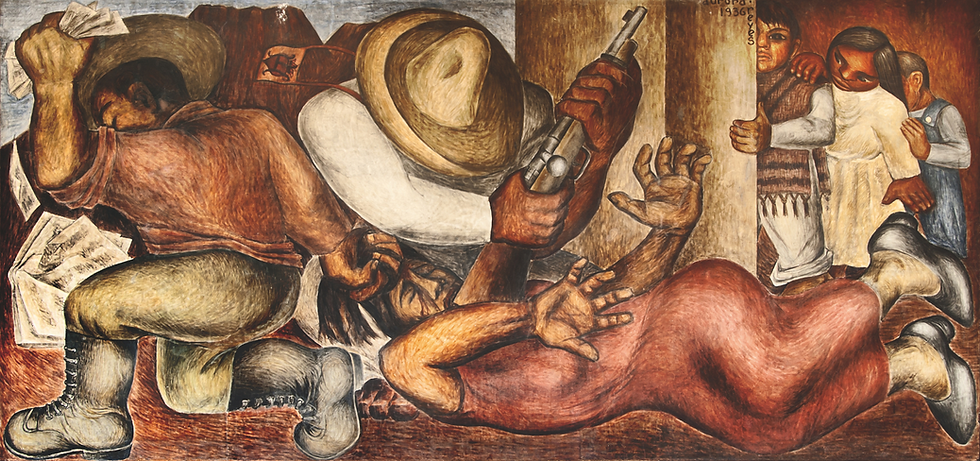
While other muralists were painting male heroes of the Revolution, Aurora placed a woman at the center of history, showing the violence faced by rural teachers and highlighting their crucial role in Mexico’s literacy movement.
Despite her talent and strength, Aurora Reyes died in 1985 almost forgotten.
Her ashes were buried beneath a magnolia tree she had planted herself in her home in Coyoacán.
Today, many of her murals are deteriorating, and her literary work still hasn’t received the recognition it deserves.

But in 2022, the National Lottery used one of her murals to commemorate 100 years of Mexican muralism.
Emilia Ortiz

Born in Tepic, Nayarit, in 1917, Emilia Ortiz was a Mexican painter with extraordinary drawing skills from a very young age.
She grew up in a well-known family in Nayarit, surrounded by a vibrant cultural environment filled with literary gatherings, concerts, and theater. However, her childhood was also marked by tragedy: her brother drowned in the sea of San Blas, a loss that deeply affected her family.
From an early age, she showed great talent for drawing, along with a strong interest in music and literature. That sensitivity later appeared in her paintings of Cora and Huichol communities, as well as in her wide collection of caricatures filled with subtle irony.

In 1933, when she was still very young, five of her caricatures were published on the front page of El Nacional, one of Mexico’s most important newspapers.
Later, alongside her sister Estela and with the support of her uncle Juan de Dios Bátiz, she exhibited her work at the Salón Verde of the Palace of Fine Arts in Mexico City, receiving praise from the capital’s press.
Her painting stood out for its exquisite expression and deep connection to the cultural identity and reality of Nayarit.

Decades later, in 2009, the Autonomous University of Nayarit awarded her an honorary doctorate.
She passed away on November 24, 2012, leaving behind a fundamental legacy for both Nayarit and Mexican art.
María Izquierdo

Born in San Juan de los Lagos, Jalisco, in 1902, María Izquierdo was a Mexican painter who literally broke borders.
She became the first Mexican woman to exhibit her work outside the country, in 1930, at the Art Center Gallery in New York.
From a young age, her life was marked by loss. Her father died when she was five, and she was raised by her grandparents. Later, she was pressured into marrying a military man at a very young age, with whom she had three children.
But María was not destined to remain in the traditional role expected of her.

In 1928, she enrolled in the Academy of San Carlos, where her teachers quickly recognized her talent.
Her first exhibition at the Palace of Fine Arts was a success. Diego Rivera wrote the introduction to her catalog and described her as “a sure and concrete value” in the Mexican artistic landscape.
Her work is characterized by intense colors, dreamlike atmospheres, and deeply Mexican themes: still lifes, landscapes, circus scenes, and above all, women.
But not idealized women as mothers or patriotic symbols.
María dared to paint silence, pain, and female melancholy. Women naked, kneeling, tied to columns, in almost metaphysical spaces. Her vision sharply contrasted with the traditional representation of women in post-revolutionary Mexican art.

In 1945, she was commissioned to paint a mural titled The Progress of Mexico City. However, once she had begun working on it, the contract was canceled.
Officially, technical reasons were given.
Unofficially, major muralists —Rivera, Orozco, and Siqueiros— believed a woman did not have the ability to execute a mural of that scale.
María publicly denounced what had happened.
Years later, after suffering several strokes, she died in 1955 in Mexico City, in precarious economic conditions.
María Izquierdo not only opened doors for Mexican women artists. She proved that the history of Mexican art cannot be told without them.
Cordelia Urueta

Born in Coyoacán in 1908, Cordelia Urueta grew up surrounded by intellectuals, artists, and diplomats. But her rebellious spirit appeared very early.
She was expelled from school for drawing nuns dressed in the front… and naked from behind. Instead of punishing her, her father hired a private drawing teacher.
She lived her childhood during the Mexican Revolution and also went through difficult moments: her father’s death, health problems, and a period of deep depression that marked her youth.
Still, she studied at the Open-Air Painting School in Churubusco, where she understood that art was not a hobby… it was a calling.

In the 1930s, she traveled to New York and Paris. In New York, she was invited to exhibit alongside Orozco and Tamayo. In Paris, she spent time with Siqueiros and other artists in the intellectual cafés of the era.
She later returned permanently to Mexico in 1950 to dedicate herself fully to painting.
Her first formal exhibition took place at the Salón de la Plástica Mexicana.
Throughout the 1950s and 60s, she exhibited in France, Japan, Peru, Scandinavia, New York, and Brazil, winning awards at major biennials.
But the most interesting thing about Cordelia was not the recognition.
It was her way of painting.

She began with portraits, but her work gradually evolved toward abstraction, without completely abandoning the human figure. She became known for her intense and emotional use of color.
In fact, she is considered one of Mexico’s great colorists and was called “The Grand Dame of Abstract Art.”
At one point, she won the National Prize for Art… and rejected it. For her, the work should transcend on its own, not because of awards or honors.
She died in 1995, leaving behind a solid, international, and deeply personal legacy.
In Conclusion
Aurora Reyes painted resistance.
Emilia Ortiz painted identity.
María Izquierdo painted female strength and pain.
Cordelia Urueta painted emotion through color.
Four women. Four different paths. Four ways of challenging what was expected of them.
The history of Mexican art is not made only of the names we constantly repeat.
It is also made of women who fought against prejudice, against oblivion, against a system that often closed doors on them… and still created works that continue to speak today.
Comments